
Exhibition
When Linen went around the World
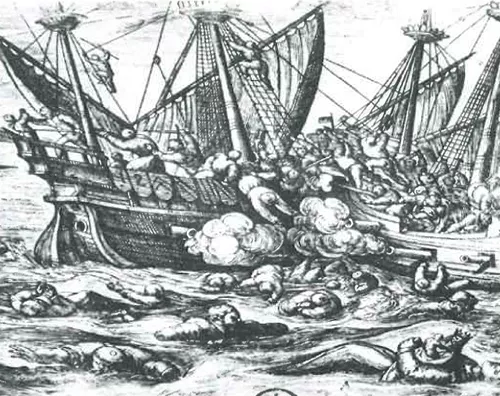
Maps, models, videos, portraits, and more will illustrate this epic story, which was also shaped by naval battles.
The rich history of Roscoff
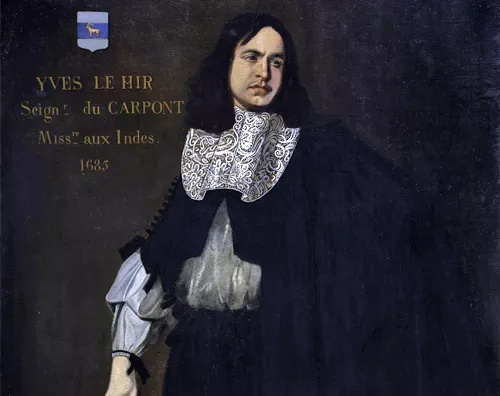
A rich history of Roscoff told through the women and men who distinguished it: shipowners, long-haul merchants, privateers, coastguards, missionaries. The fundamental role of women in the Léon region during this era.
The “Maison Amiral,” future home of the Musée Amoureux de la Bretagne (Museum of Brittany in Love), is a remarkable historic residence built in the 16th century and occupied for generations by families of shipowners and merchants. In today’s terms, one might say they were great entrepreneurs of the first wave of globalized trade.
An overview of its history
A merchant’s house that has been extended and rebuilt

Roscoff offers heritage lovers magnificent buildings adorned with a rich array of ornamental inscriptions. Its church (1522–1545), its enclos (parish close), and its two ossuaries are on the candidate list for UNESCO World Heritage status as part of the “Enclos Paroissiaux” (Parish Closes). The Léon region and its surroundings boast châteaux and numerous manors, mansions, and chapels that are true jewels to behold… and yet nearly all of them date from the same period. Why?
These monuments, found in Saint-Pol-de-Léon, Morlaix, Saint-Thégonnec, Guimiliau, Pleyben and elsewhere — mainly in Finistère but also in Côtes-d’Armor, Morbihan, and even Ille-et-Vilaine — are the result of a unique historical convergence that emerged at the end of the 15th century: the meeting of Christian faith, energized by the Catholic Counter-Reformation, with the exceptional economic boom driven chiefly by linen weaving and the cloth trade, set against the backdrop of the age of great discoveries. This export activity toward England, Spain, and the Americas — extraordinary for its time — proved especially lucrative. The carved ships adorning the façade of Roscoff’s church leave no doubt as to the source of the money that paid for its construction and decoration. 
The great ground-floor hall of the Musée Amoureux de la Bretagne will tell the story of this period of Breton history — this “wonderful blend of contemporary art and local craftsmanship, of Church doctrine and popular beliefs, which gave rise to an original and richly varied world” (François de Beaulieu, ref. below).
This Historical Notice draws on and shares excerpts from the comprehensive work of Professor Alain Croix: “L’âge d’or de la Bretagne 1532–1675” (The Golden Age of Brittany, 1532–1675). In his introduction, the author cites the Sire de Montmartin, writing in the aftermath of the Wars of Religion, describing Brittany’s wealth as a “Little Peru” — a reminder that 16th-century minds were deeply marked by the idea of El Dorado! This is a far cry from the image of a Brittany that had always been poor and underdeveloped, an image conveyed chiefly under the Third Republic.
Brittany in french foreign policy
In fact, the Brittany of this “golden age” was far removed from the strategic concerns of the time of Marignano (1515) or the Treaties of Westphalia (1648). France was frequently at war during this period, but for Brittany, the century and a half from 1532 to 1675 was a time of peace.
The province supplied few men, since there was no conscription. At the time, Brittany rarely had royal troops stationed on its soil. The province’s military commander, the governor, held little real authority. One of the few notable initiatives, the construction of the Château du Taureau in the Morlaix river between 1544 and 1552, was funded by the town itself, whose residents also provided its garrison.

Brittany was of course a maritime frontier province, peaceful only because the strategic choices of the kings of France and England did not lead them into major confrontations during this period, and because the Spanish fleets were occupied elsewhere, in trade with the Americas or against England. The turning point would not come until around 1667–1680. The great confrontation between France and England that then took shape would restore real strategic importance to the Breton frontier, driving the military development of Brest — but bringing a brutal halt to the region’s economy.
This relatively peaceful period also spared Brittany the Wars of Religion, since Protestantism had little influence there. It did, however, experience conflict during the League, which pitted Catholics against each other — those rallied behind the Duke of Mayenne, brother of the Duke of Guise, against King Henri III and then, after his assassination on 1 August 1589, his successor Henri IV. For more than two years, Brittany was left at the mercy of the operations — militarily insignificant but terrible in their consequences — of warlords such as Guy Éder de La Fontenelle (officially a member of the League). It is in fact likely that today’s “Maison Amiral” was rebuilt after being ravaged by Fontenelle.
An economy of plenty
But let us return to the economy of this land of plenty, which bequeathed us magnificent historic buildings and an image that persists to this day. The isolation of Brittany at the time — both globally and internally — is more than relative: it is a myth, a glaring anachronism in reading the landscape of a province that was, on the contrary, among the most open and accessible in the kingdom, within a context that was far more European than national.
At the accession of Louis XIV, Brittany had 1,800,000 inhabitants — one of the kingdom’s largest population centers, accounting for 9 to 10% of the king’s subjects, a share it would never regain.
While today the region is seen as essentially agricultural, in the 16th and 17th centuries Brittany was a major industrial region with an international reputation and international markets. Breton products were found in the Philippines and in Peru, in England and in Spain…
Brittany was, in the context of the time, rich in industrial energy drawn from wind and, above all, from water — water harnessed even on modest rivers. Mills were highly developed, including tide mills, which appeared as early as the 12th century and were often paired with windmills: no fewer than four could be found, for instance, on the small island of Batz, facing Roscoff!
Brittany and the Léon region were exceptionally well placed in what was the leading industry of the 16th and 17th centuries: textiles. Flax and hemp, which thrive in damp conditions, found favorable growing conditions there.
The extraordinary maritime adventure that began in Europe at the end of the 15th century calls to mind illustrious names, from Christopher Columbus to Vasco da Gama, distant horizons from the Americas to Java, ships — caravels or galleons — and, more broadly, the famous Indies route from Cádiz to the Americas.
Brittany played an active part in this adventure through supply and provisioning, a highly profitable business: sails were made of hemp canvas, and more prosaically, goods traveled for the most part in “bales” wrapped in hemp cloth. This was therefore a rapidly expanding market on a European scale. Breton suppliers held the leading position, thanks to their proximity and long-standing ties with Spain, undisturbed by any conversion to Protestant heresy.
The true development of flax cultivation was linked to the import of Flemish linseed, which produced a much taller plant than the Breton variety. This import trade began in 1590 via Roscoff. A few decades later, seed arrived by the barrel from the Baltic Sea “in much greater quantity than before,” as one author noted in 1636. In this way a thriving linen-cloth industry developed rapidly: weaving took place in the countryside, while trade was controlled by the towns.
Linen cloth was by far France’s leading export industry, both in the value of production and in the value of exports. Nearly a third of all goods shipped from Europe to Spanish America via Cádiz consisted of linen cloth, of which 75% was French — and half of that came from Brittany. It is a staggering figure! One-eighth, by value, of all European exports to Spanish America, from California to the Río de la Plata, was made up of Breton linen cloth.
The famous square of Locronan, the parish closes of what is now Finistère, the fine shipowners’ houses, the magnificent altarpieces of so many rural churches, so many works of art, so many bell towers, so many manor houses… all of it was built on linen cloth.
Brittany’s flourishing economy — its “golden age” — was sacrificed following the introduction of Colbert’s second customs tariff in 1667 (after the one of 1664). A trade war was then waged against the United Provinces and against England through the doubling of duties on manufactured goods (cloth, wool, lace). The retaliation of the two targeted powers set in motion the slowdown of the linen-cloth trade, all the more so as England chose to source its supplies from the Nordic countries, such as Holland, rather than from Brittany. The spiral of wars that followed only made matters worse, and the economic boom of the Léon region and its surroundings came to a complete halt.
The « Maison Amiral » — Musée Amoureux de la Bretagne — will share in the destiny of this history and its Roscoff protagonists: a story of dynamism, of openness to the world, and of rural economies closely bound to those of the ports.
Sources:
L’âge d’or de la Bretagne 1532 – 1675, Alain croix, Éditions Ouest France Université, 1993
Enclos paroissiaux, Hervé Quemener et Jean-Yves Guillaume, Éditions Géorama, 2019
Enclos paroissiaux de Bretagne, François de Beaulieu et Hervé Ronné, Éditions Ouest
France, 2025